Anthology archaeology: how Henry Treece’s horror story became a children’s adventure

One of the pleasures of collecting Henry Treece is the constant probability of unearthing obscure material in published collections, a sort of anthology archaeology if you will. Whenever I browse second hand bookshops I make a point of checking poetry collections and compilations of children’s stories, just in case there’s a Treece contribution to be discovered. Most of the the time there’s not, of course, but just occasionally my stomach flips and a sale is assured. In this post I present an example from my collection, which led me in a bibliographic direction I had not anticipated.

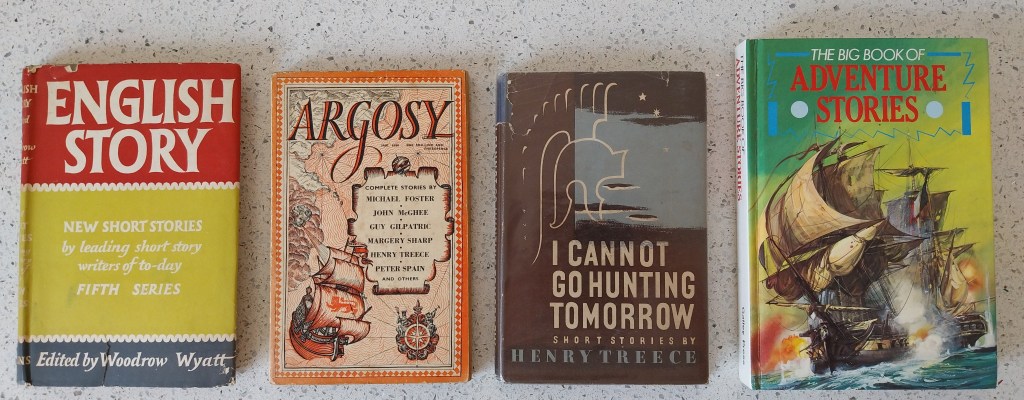
This archaeology begins with The Big Book of Adventure Stories, published by Hamlyn for Galley Press in 1986, which I picked up in a charity shop some years ago. With its brightly coloured cover of sailing ships firing broadsides at one another, it looks exactly like the sort of book that might once have appeared under a Christmas tree for an adventure-hungry child. The 1986 volume appears to have been the last in a long-lived sequence of repackagings of earlier anthologies originally edited by Eric Duthie.

The first story in the collection is Treece’s “The Visitor”, which initially entered this particular publishing stream in Mystery and Adventure Stories for Boys (Odhams, 1962); material from that and Duthie’s Open-Air Adventure Stories for Boys (1965) was subsequently brought together in the much larger Big Book of Boys’ Adventure Stories (Hamlyn, 1977). The 1986 Galley Press volume was another, shorter selection from this material, with its copyright page explicitly recording 1962, 1965 and 1977 before giving 1986 as the date of the new edition. I have so far found no later edition in this particular sequence.

Reading “The Visitor” in this book I was struck by its rather bizarre setting and violent themes (more of which later) plus some internal inconsistencies in the writing and a weak ending. It turns out that these were caused by this children’s story being a heavily edited version of a story originally for adults that had been substantially rewritten for younger readers

As far as I have been able to determine, there were four printings of “The Visitor”:

  • Its first appearance in a prose anthology called English Story: Fifth Series in 1944;
  • A reprinting in the magazine Argosy in January 1946;
  • It then turns up in Treece’s first prose collection I Cannot Go Hunting Tomorrow, also in 1946;
  • Finally, the version published in Mystery and Adventure Stories for Boys in 1962, which was later recycled into the 1986 volume.

The first three of these occurrences are essentially the same story. There are small differences of punctuation and presentation, but the text remains remarkably stable. Then, in 1962, something dramatic happens. The basic plot remains intact: A teenage boy is left alone to look after the family farm while everybody else goes to market. Enjoying the responsibility, and sneaking a cigarette, he is suddenly confronted by a strange old man who forces his way into the farmhouse.

The visitor is a wonderfully unpleasant Treece creation: filthy, emaciated, unpredictable and repeatedly described in animal terms. There’s also a suggestion that he may in fact belong to a different time and place, in his archaic language and his rejection of paper currency and a demand for gold coins. He produces a homemade knife, demands food and money, terrorises the boy and orders him onto his knees. Eventually the boy knocks him down, but when he returns with water the old man has disappeared.

Even in the children’s version this is pretty dark stuff. But the original goes considerably further.

Some of the changes made in 1962 are simple sanitising. “Young swine” becomes “young brat”; “Damn you” becomes “Blast you”; and “God, how safe I felt!” becomes the rather more respectable “Heavens, how safe I felt!” The violence is also toned down. In the original, the boy stamps on the old man with his “heavy, steel-shod farm boots” and feels the metal tip grate against his shinbone. That detail disappears.

More strikingly, the visitor’s homemade knife loses some of its personality. In the original he proudly calls it a “belly-slitter, a real gut-nicker” and talks enthusiastically about “nice necks” opening under its blade. In the children’s version the knife remains, because the story needs it, but much of the sadistic relish has gone.

The biggest change, though, concerns Elsie Hodgson, the family’s “day-girl”. In the original story she is mentioned while the frightened boy imagines who might return to the farm and rescue him. Later, the visitor notices a flowered cotton overall belonging to her and becomes interested. The old man then launches into a distinctly disturbing fantasy about what a “nice girl” Elsie must be, the flowers she wears, and that she must be “A nice bit of girl for taking in the hay”.

At first this seems merely another part of his grotesque rambling, but its significance becomes clear only at the end. The following morning the boy goes with his father to the police station, carrying the visitor’s knife wrapped in brown paper. It has been found in the barn, covered in blood, beside Elsie Hodgson, “whose head was almost severed from her poor naked body.” And that is where the original story ends.

It is a brutal piece of writing, particularly because Treece has prepared us for it without making the connection explicit. The old man’s fascination with knives and necks, his interest in Elsie, and his strange mixture of sexual and violent imagery suddenly acquire a much darker meaning.

This sadistic darkness is already there in the very first version of the story in 1944, Argosy printed it unchanged in 1946, and Treece retained it when he collected the story later that year. But it could hardly survive in a boys’ adventure anthology. In the 1962 version Elsie effectively disappears. The earlier references to her are removed, as is the old man’s disturbing interest in the day-girl, and because Elsie has gone, the ending has to be rewritten completely. Instead of the boy carrying a blood-covered knife to the police station after Elsie’s murder, the Inspector produces the knife himself and tells him: “Another was not so lucky.”

The story then ends with a completely new sentence: “There was no more jeering at home”, referring to the fact that the boy’s family were sceptical of his account.

It is a fascinating shift, in which a rather nasty adult horror story has been turned into something much closer to a conventional children’s adventure: frightening things happen, the hero survives, and in the end the adults have to admit that he was telling the truth. What I find particularly interesting is that the 1944–46 text was so stable. Treece himself does not appear to have gradually softened or reshaped the story. For nearly twenty years “The Visitor” existed as a piece of adult fiction, complete with the swearing, the “gut-nicker”, the sexual menace and Elsie’s almost decapitated naked body. Only when it entered the world of children’s publishing did all of that disappear.

Whether Treece himself made the alterations for the 1962 anthology, or whether the editor Eric Duthie or somebody at Odhams did the work, I don’t yet know. But somebody went through the story very deliberately, deciding what could stay and what could not. Menace was acceptable. Violence, within limits, was acceptable. The knife could stay. The boy could still be forced onto his knees to kiss the old man’s feet. But the sexual threat, the sadistic language and Elsie Hodgson had to go.

By 1962, Treece was starting to become much better known as a writer of children’s stories and so this adaptation of an adult story is not so surprising. However, as far as I know “The Visitor” was a one-off and I am not aware of any other adaptations. But who knows – some additional anthology archaeology may turn up more examples.
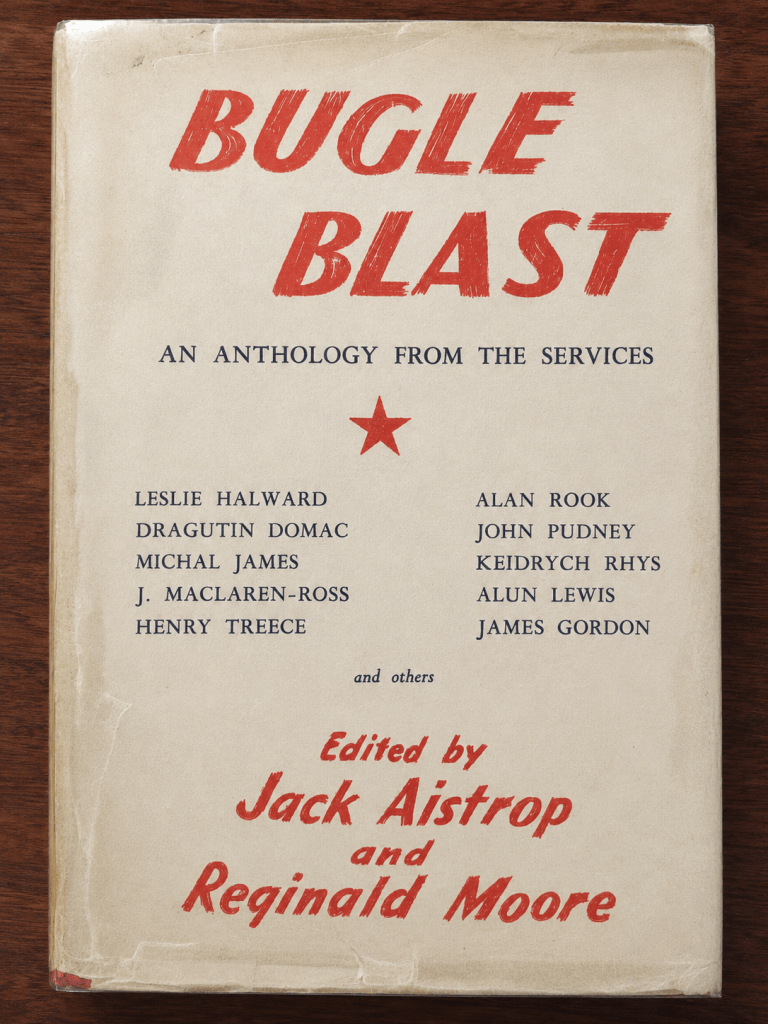
A recent find for the collection: Bugle Blast (1943)

Another small gap in my Treece collection has been filled, this time with a rather nice copy of Bugle Blast: An Anthology from the Services, edited by Jack Aistrop and Reginald Moore and published by George Allen & Unwin in 1943. It was the first of what eventually became four Bugle Blast anthologies published between 1943 and 1947, though this is the only one in which Treece appears.

My copy retains its wonderfully austere red-and-grey dust wrapper, very obviously a product of wartime publishing, covering stiff boards that mirror the front of the wrapper, though the back board remains plain. The verso of the title page carries the familiar lion-and-book symbol announcing that its paper and binding conform to the Book Production War Economy Standard. It was printed by W. S. Cowell of Ipswich and London.

The idea behind Bugle Blast was to showcase imaginative writing emerging from the armed forces. Although almost all of the 23 contributors were servicemen, the publishers explicitly intended the series to provide an opening for young women in the forces too. Michal James was the sole woman represented in this first volume, according to a contemporary advertisement for the book in the anthology Million – New Left Writing. The dust wrapper explains that the editors were interested less in straightforward reportage of the war than in the imaginative writing emerging from it, and hoped that the volume might encourage younger servicemen to continue writing. The contributors were given considerable freedom: as the editors put it, rather nicely, “they wrote as they pleased.” Treece, as we will see, seems to have taken this to heart.

Treece was in interesting company. Among the 23 contributors were Alun Lewis, Sidney Keyes, John Pudney (with whom Treece later collaborated as co-editors), Jocelyn Brooke, Julian Maclaren-Ross (who deserted from the army the year that Bugle Blast was published), and Woodrow Wyatt. I’ve not been able to find any biographical information about Michal James – her contribution, the rather dark short story “Out-Patients Only”, seems to be all that remains of her published work. If anyone can tell me more about her, please leave a comment below.

At this time, Treece was serving as an intelligence officer in the RAF. His contribution, “The Conscripts”, occupies pages 93–95 and opens the section rather oddly entitled “Singing & Surveying”. This short poem is very recognisably Treece at this stage of his career. Published only a year after his Faber collection Invitation and Warning (1942), it mixes physical violence and despair with the startling natural imagery that runs through so much of his early poetry. There are rabbits, peonies, hyacinths, a lark and, most strikingly, a cherry tree that bends down towards the suffering soldier and promises that fruit will eventually follow blossom despite everything that birds and men may do to it.

The final section moves into something more visionary and characteristically Apocalyptic: the damaged young men of the war become almost mythological figures, simultaneously glorious and despairing, the living and dead merging together. It is not understated poetry, but understatement was hardly the point of the New Apocalypse.

One line is particularly arresting in a poem published by a serving officer in 1943. The wounded conscript asks, “Why must I suffer for a nation’s lies?” Seen in the context of Treece’s later anarchist sympathies, this seems more than conventional wartime disillusionment and reflects a deeper suspicion of nationalism, authority and the claims made by states upon individuals. Yet the poem is not simply anti-war and in later lines Treece remains capable of celebrating the courage and sacrifice of the conscripts themselves. The distinction between the nobility of the individual and the questionable causes imposed upon them is an important one and Treece returned to this theme time and again.

What particularly appeals to me about books such as this is that they put Treece back into his original literary context. Long before The Dark Island, the Viking books and the historical novels for which he is now chiefly remembered, he was a wartime poet appearing alongside some of the most interesting young British writers of his generation. Bugle Blast is a modest little book, printed on economy paper in the middle of a war, but it well captures such a vital time in British history and culture. Needless to say, I’m pleased to have found a copy with its dust wrapper still intact, albeit price-clipped.

As far as I know, “The Conscripts” does not appear in any of Treece’s poetry collections and has not otherwise been re-printed since it appeared in 1943. Below is the whole poem, assembled into a single page using AI.

Recent additions to the collection: two Treece-adjacent books of poetry

A visit at the weekend to a local book fair yielded just a single Treece item: a slipcased copy of the Viking Trilogy, rebadged as A Viking Saga (Puffin, 1967), that I’ll save for a later post. I did however also pick up two Treece-adjacent items.

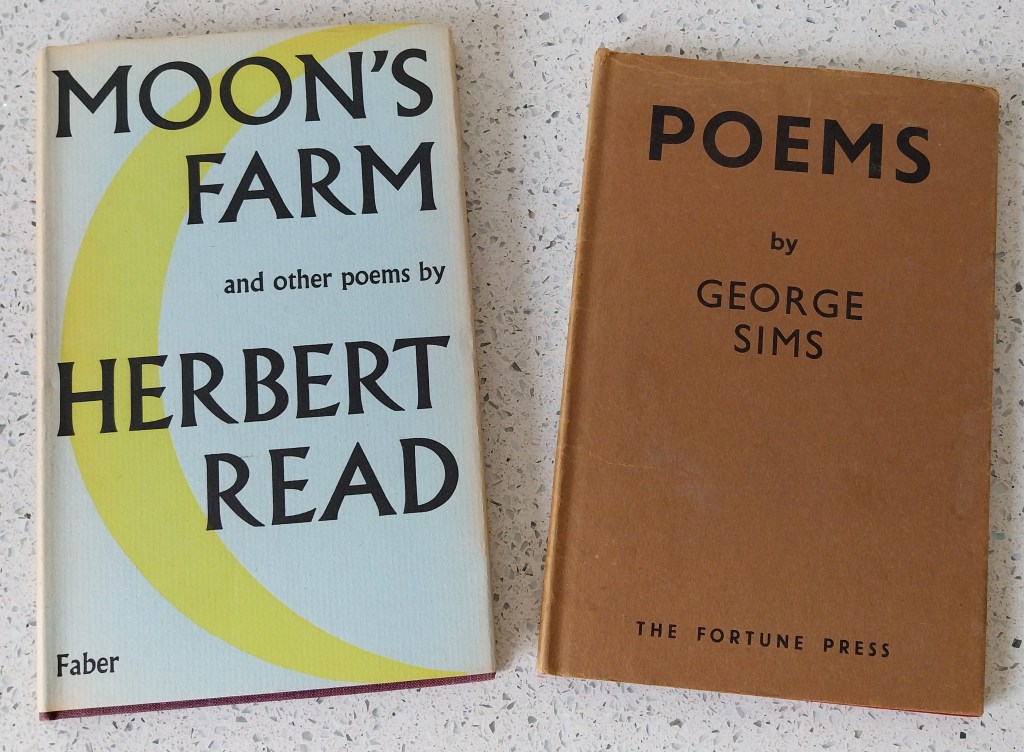
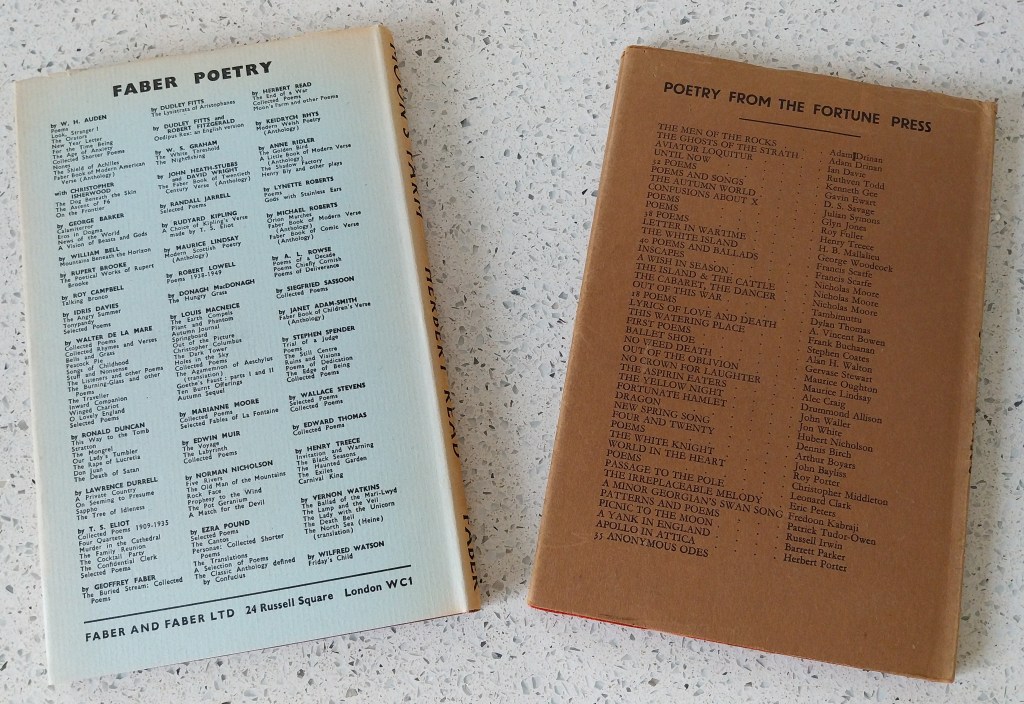
The first is Moon’s Farm and other poems (Faber and Faber, 1955) by the art critic and anarchist Herbert Read. There’s a number of personal connections between Read and Treece, not least in Read’s championing of New Apocalypse writers and his influence of Treece’s own anarchism. More on that at a future date. Five of Treece’s volumes for Faber and Faber are listed on the back of the dust wrapper.

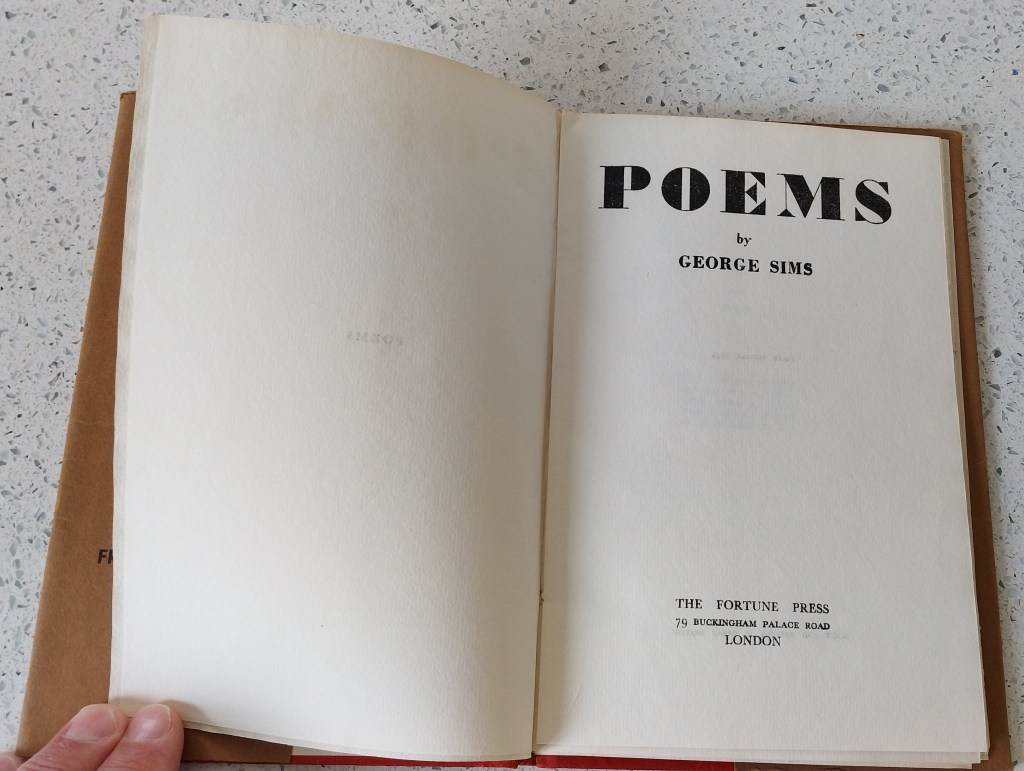
The second book is by a writer I’d not previously encountered – George Sims, whose Poems was published by The Fortune Press in 1944. Fortune Press had also published Treece’s first book – 38 Poems – in 1940, and it’s likewise mentioned on the back of this book. So both writers were part of the small-press poetry world associated with The Fortune Press in the 1940s. Whilst Treece moved over to Faber and Faber, Sims went on to publish The Immanent Goddess (1947) with that publisher and was also included in Fortune’s 1949 Poems of the Forces anthology (which, oddly, does not include anything by Treece – perhaps for copyright reasons?).

When I opened Poems I was immediately struck by the quality of the paper, which is nice and heavy and has scarcely discoloured. This is a complete contrast to most books of that era, which were subject to war time restrictions and tended to use poor quality paper. The volume is very slim, however, just 24 text pages.

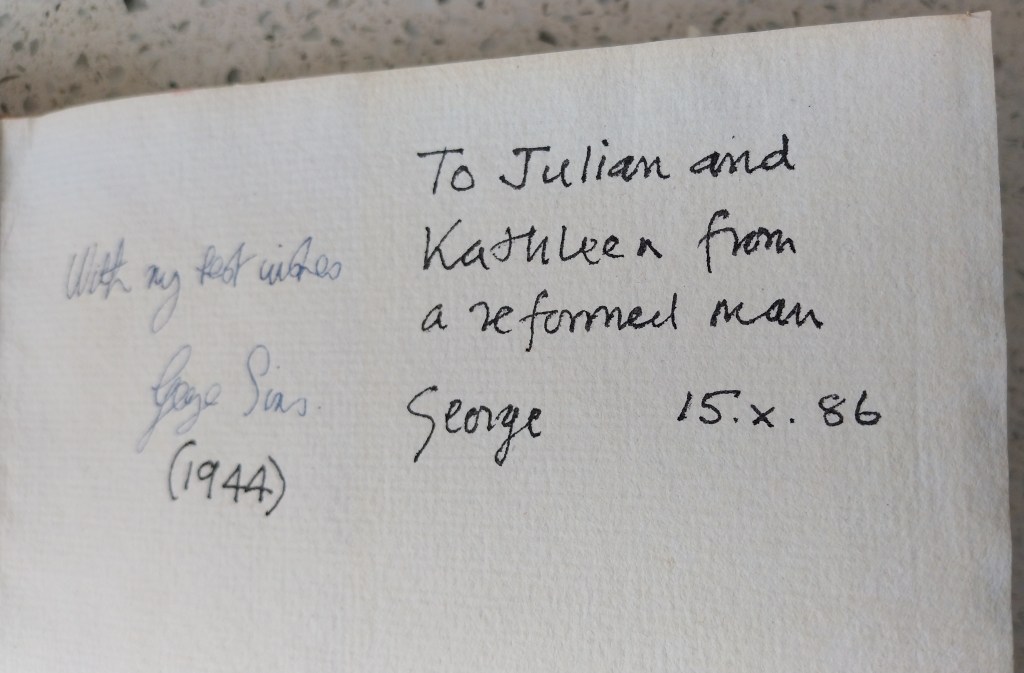
The other thing that drew me to Sims’s book is that it was signed twice by the author, on occasions 42 years apart! Presumably he had intended this to be a presentation copy but did not hand it over after the first signing in 1944 – according to his obituary Sims “was essentially a private and reclusive man [with] an offbeat sense of humour [who] did not suffer fools gladly: indeed it has been said of him that he refused to suffer them at all”. In 1986 it seems that he finally found two people who might appreciate his work. It’s fascinating to see how his handwriting changes over that period and I’m intrigued by his self-description as a “reformed man” – what was he referring to I wonder?

A bit of sleuthing leads me to conclude that the receivers of the book were the writer Julian Symons and his wife Kathleen, with whom he was friends. Symons was also published by The Fortune Press, in 1939 and 1943, and he and Treece are known to have corresponded, again justifying (to me at least!) the purchase of a book that’s Treece-adjacent. [UPDATE: Since I posted this yesterday I’ve learned that Symons founded a poetry magazine called Twentieth Century Verse that was published from 1937 to 1939. I’ve looked at the contents pages of all of those that are listed in the Modernist Magazines Project and I see no mention of Treece, however some issues are missing. I also found out that he edited a volume called An Anthology of War Poetry (1942) as part of Penguin’s Forces Book Club. I’ve yet to discover if Treece is included in the collection].

When collecting books by a particular writer there’s always the temptation to stray into related territory. That can soon lead to an exponentially expanding collection correlated with a rapidly diminishing bank balance, so I try to resist that temptation But these two books – at £5 apiece – were bargains. I had actually spotted them the last time this fair set up camp in town but had passed; since then they’d weighed on my mind, so I was glad to see their slim spines still peaking out of a whole shelf of poetry and to be able to add them to my collection.

Joan Baez sings Henry Treece – no, really!

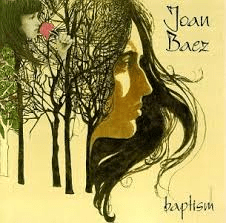
This is one of those literary oddities that sounds made up until you go and check it. But it’s true: on her 1968 album Baptism: A Journey Through Our Time, social activist and folk musician Joan Baez recorded not one but four poems by Henry Treece, with Old Welsh Song appearing twice, as both opening and closing piece. On this record, Treece was not some marginal inclusion tucked away in the middle of the track list: he is one of the most strongly represented poets on an album that also featured much more famous writers such as William Blake, John Donne, Walt Whitman, and James Joyce.

Although Treece is best known as an author of children’s historical novels, his first forays into print were as a poet and essayist. I’ll have more to say about that in future posts, but by the time Baez released Baptism, Treece had been dead for about two years, and his last poetry collection – The Exiles (Faber & Faber, 1952) – had appeared a decade and a half earlier. Indeed, following its publication, Treece more or less gave up poetry.

That immediately raises a first question: how on earth did Baez come across Henry Treece? There’s no evidence, at least none that I’ve been able to find, of any personal connection between them and the sleeve notes on the reverse of the album simply provide a potted biography. But Treece was by no means unknown in the United States by 1968. His poetry had been appearing there since the early 1940s, first in little magazines and small-press publications, then in book form. An American edition of his Collected Poems was published by Knopf in New York in 1946, and he also appeared in American anthologies, including Kenneth Rexroth’s The New British Poets in 1949. In other words, Treece’s work was available on American shelves, even if he was never exactly a household name.

The really interesting detail is that the poems Baez chose come from several different Treece books, not just one convenient anthology. One can be traced to Invitation and Warning from 1942, another to The Black Seasons from 1945, and another to The Haunted Garden from 1947. That suggests a genuine act of selection rather than a casual skim through a single volume. The most likely explanation, then, is not some lost meeting between Baez and Treece, but a literary route: books, libraries, publishers, editors, and the wider mid-century Anglo-American poetry network. Kenneth Rexroth may well have been part of that broader chain, since he helped introduce Treece to American readers and also has work on the same Baez album, but that remains informed speculation rather than documented fact. It’s intriguing to note, however, that Rexroth was active in the anarchist movement in the USA at the same time that Treece was flirting with anarchism in Britain. Perhaps there’s a political connection? Again, I’ll explore Treece’s politics in later posts.

The second question, of course is: how do they sound, what did Baez do with these poems? Let me start with what is arguably Treece’s best known poem, The Magic Wood, which frankly Baez and her collaborators make a bit of a hash of. This surreal, mystical piece about uncanny encounters in a strange woodland is best performed as a slow reveal – listen to this setting of Peter Capaldi’s reading, for instance. That version comes from a BBC Radio 4 programme presented by Neil Gaiman in which he describes the influence of this poem on his comic book series The Sandman. In contrast, Baez’s version is a gallop through faerie, as though she doesn’t really understand what’s going on and can’t wait to get to the end! In contrast, Who Murdered the Minutes is a much better fit to her voice and delivery. The two versions of Old Welsh Song that begin and end the record (and they are different if you listen closely) are likewise fine renditions of this short piece.

So yes: Joan Baez really did sing Henry Treece. And not by accident. Somewhere in the background lies a small but fascinating story of transatlantic literary circulation, of how a poet associated with a small, slightly obscure British literary movement, the New Apocalypse, found his way onto an ambitious late-1960s record by one of America’s best-known folk singers. Strange, unlikely, and entirely real.

The Celtic Tetralogy: publication dates versus historical chronology

In the first post on this blog I discussed how I had come (back) to Henry Treece via the unexpected discovery of his Celtic Tetralogy, which was re-issued by the publishers Savoy in the 1980s. This sequence of historical novels is slightly unusual in that the order in which the books were published is not the same as the order in which their stories unfold in time.

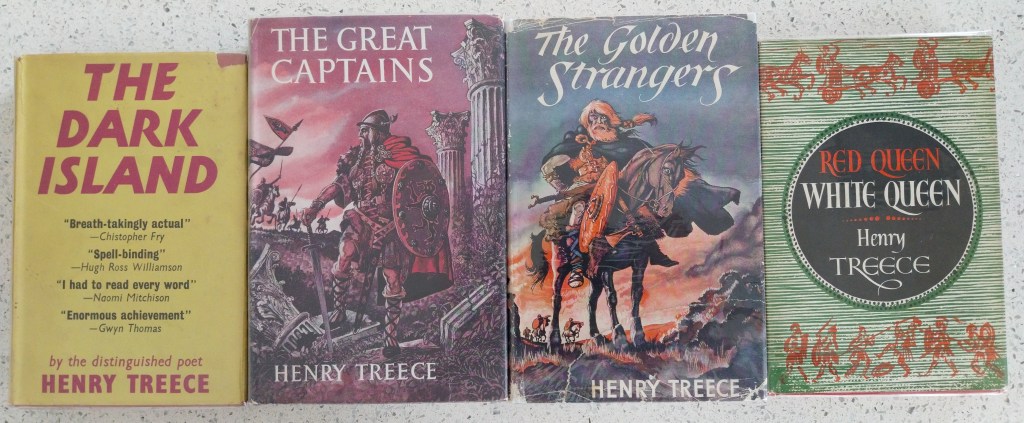
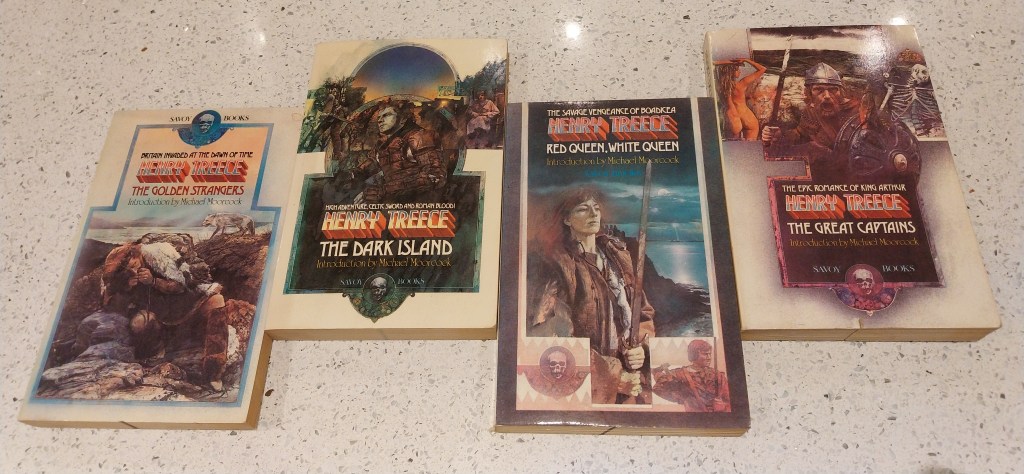
The first book to appear (and indeed Treece’s first novel) was The Dark Island in 1952. Then, in 1956, came both The Golden Strangers and The Great Captains. It was another two years before Red Queen, White Queen followed in 1958. You can see the order of publication, based on the copies in my own collection, in the image above.

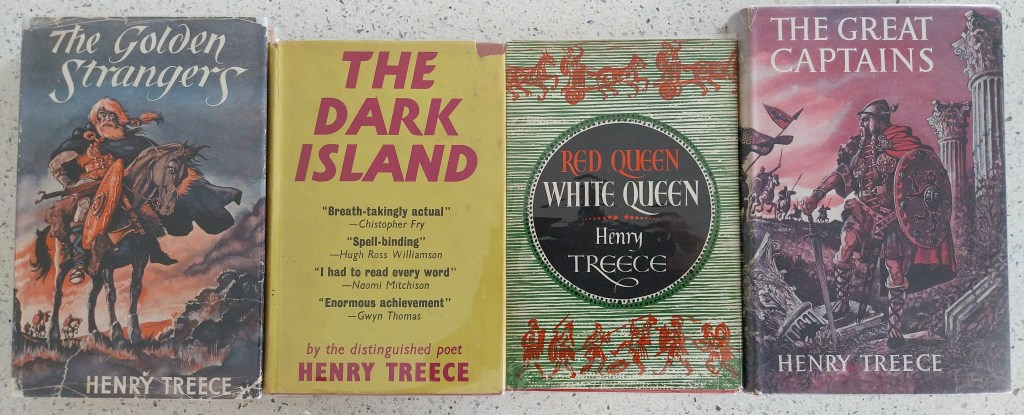
Read chronologically, however the sequence runs from The Golden Strangers, about the coming of the Celts to Britain, through The Dark Island, centred on Caratacus and the Roman invasion, then Red Queen, White Queen, which revisits Roman Britain through the rising of Boudicca, and finally The Great Captains, Treece’s stripped-down, post-Roman Arthurian novel. Like this:

So Treece did not build the tetralogy in neat historical progression; he assembled it more obliquely, moving backwards into pre-Roman Britain and forwards into Arthurian Britain only after beginning in the thick of Rome’s collision with the native peoples of the islands.

That mismatch tells us something about Treece as a novelist. He was less interested in writing a tidy sequence than in exploring a long age of cultural conflict: invasion, resistance, collapse and reinvention. The books gain extra force when read in historical order, but their publication order shows how Treece discovered this imagined Britain in fragments, circling around the great breaks in its story rather than marching through them step by step. Indeed, his second novel, The Rebels (1953), which I will deal with in a later post, is set in the 19th century.

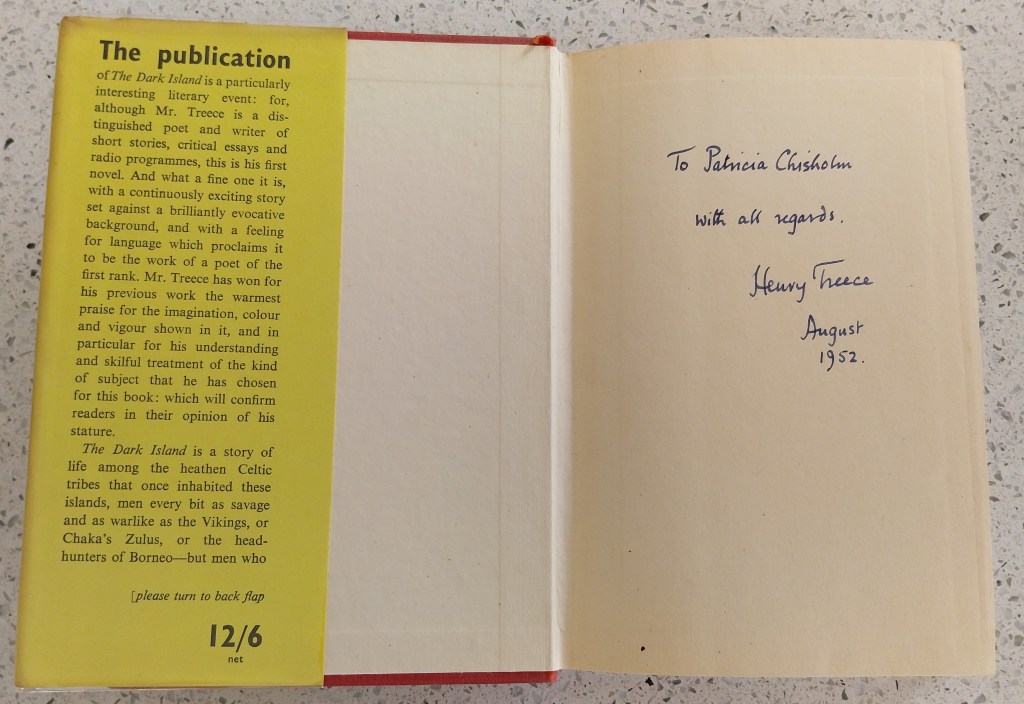
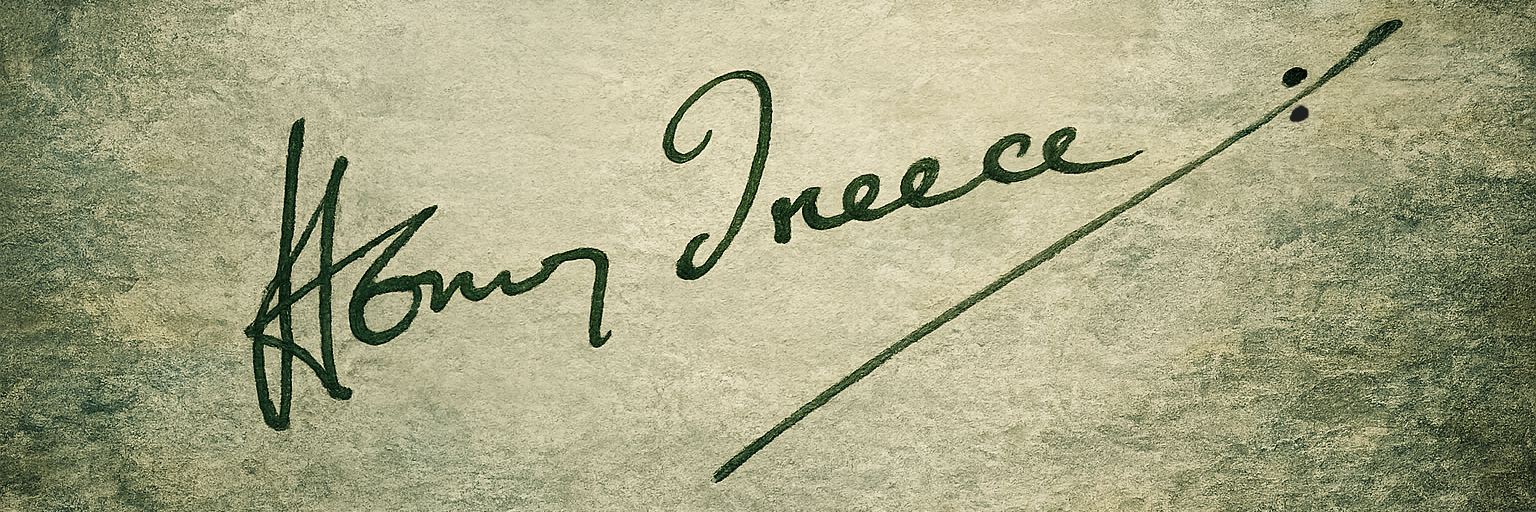
Those copies from my own collection are all first editions, though they vary in their condition, especially the dust jackets. Only one of them – The Dark Island – is signed:

I’ve not been able to track down the Patricia Chisholm to whom the book was inscribed – she’s certainly not an obvious literary figure. She may well have been a private acquaintance of Treece’s, quite possibly from his Humber/Lincolnshire circle. A quick search of online newspapers suggests that The Dark Island was published in the summer of that year, so this is an early signature.

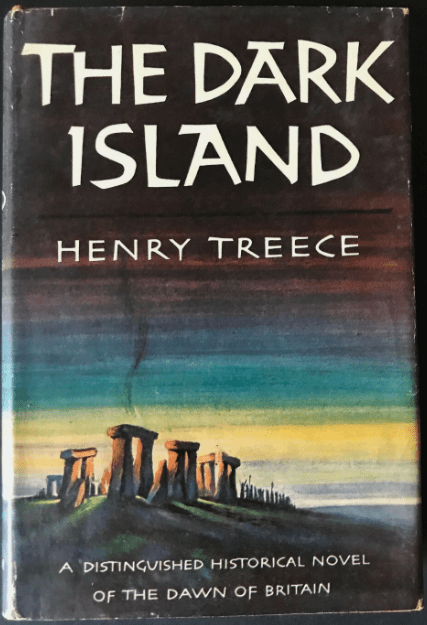
Signed copies of Treece’s first novel are relatively rare – I’ve not seen one listed on AbeBooks for some time, and when they do appear they command relatively high prices (£100+). The American edition of The Dark Island appeared in 1953 and it has a much nicer cover than the British version, with it’s standardised Gollancz-Yellow dust jacket:

Regardless of the order that you read them in (and they are all stand-alone novels) the Celtic Tetralogy is a fine series of books dealing with a fascinating period in British history.

Coming (back) to Henry Treece

For those of us who were born in the 1960s, the name Henry Treece is a familiar one, even if, with the passage of time, we have forgotten it. Treece’s historical children’s novels regularly featured on junior school reading lists and in the offerings of book clubs such as the Puffin Club. That’s certainly how I first encountered this most British of writers, through an enjoyment of his Viking Trilogy – Viking’s Dawn, The Road to Miklagard, and Viking’s Sunset – three of the best books of the genre ever written, in my opinion.

As I grew older, these stories, and Treece’s name, faded from my memory, occasionally recalled as half-remembered fragments of school reading or the viking stories being a gateway into more adult books by Tolkien and Howard. Until one day, in the 1980s, I unexpectedly encountered Treece again, juxtaposed with one of my favourite fantasy authors, Michael Moorcock.

Moorcock had provided the introductions to new editions of four of Treece’s novels – his Celtic Tetralogy – published by Savoy Books. They are shown in the photo above and I’ll write a longer post about these in the future. For now it’s enough to know that I spotted them in the remainders pile in the book section of a local department store. Picking them up I was confused. These were not short, lightly framed stories for children, they were long, densely conceived adult novels. It was a revelation! I had no idea that Treece wrote for grown ups. I bought all four books, took them home, and read them.

So began my journey back to Henry Treece. Indeed, it was the start of a bit of an obsession with collecting his books and other publications. Forty years of collecting later it’s time to share this passion for Treece’s work, and the collection that I’ve accumulated over the years, with a wider audience. Because Henry Treece is, I feel, one of our most neglected writers. He’s remembered, if he’s recalled at all, as primarily a writer of fiction for kids. But there was so much more to him than that as I plan to show on this blog. As well as showcasing my own collection I’ll highlight the breadth of his work and how Treece influenced both his contemporaries and later authors.

If you’re a fan or a collector of Henry Treece I’d love to hear from you – comments are open, please do leave your thoughts. For now, though, I’ll leave the last word to Henry Treece himself, from his 1946 volume How I See Apocalypse, who defined himself as a writer:

“…who senses the chaos, the turbulence, the laughter, and the tears, the order and the peace of the world in its entirety…”